
Why Enterprise Productivity Is Still Dropping Despite AI Adoption
Updated On:
August 25, 2026

AI usage is up. Time inside tools has grown eightfold. The productivity numbers still don't add up. That gap has a name and closing it doesn't require another tool.
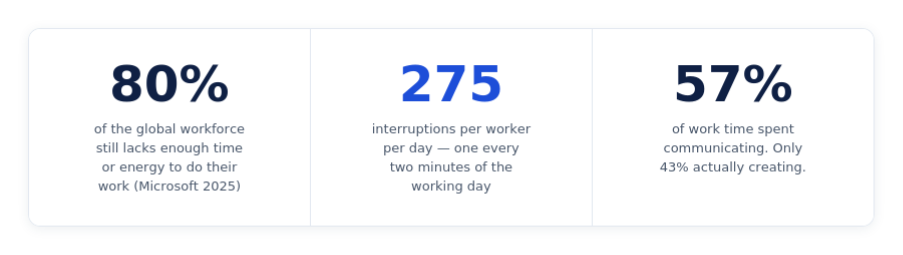
You gave your teams AI. Eighty percent are using it. By every adoption metric, the rollout worked. And yet Microsoft's 2025 Work Trend Index found that 80% of the global workforce still doesn't have enough time or energy to do their work (Source: Microsoft Work Trend Index 2025).
The tools arrived but the relief didn't.
Something is consuming the gains before they land. The instinct is to buy more tools, add more
capability, run another pilot. That's exactly the wrong response to what's actually happening.
The organizations pulling real productivity gains from AI aren't the ones with the most tools. They're the ones that understood attention is the scarce resource and built systems to protect it.
Why Productivity Still Drops When Adoption Goes Up
The gap between adoption and outcome isn't random. The tools landed in an environment designed to interrupt people every two minutes. That's not a capability problem. It's a system design problem.
Why Tool Adoption Alone Isn't Enough
When organizations get serious about productivity, the logic feels sound. Reduce manual work, automate repetitive tasks, deploy a capable suite across the team. It works impressively well at the individual level.
Then you look at the organization as a whole. The gains show up in individual output, they disappear somewhere between the person and the team.
At the organizational level, AI productivity gains often disappear between execution, coordination, and recovery time.
Why AI Tools Increase Burnout Instead of Reducing It
ActivTrak analyzed 443 million hours across 1,111 organizations and found the mechanism. Productive hours increased 5% with AI, but focus efficiency dropped to 60%, a three-year low. Disengagement risk rose 23% (Source: ActivTrak 2026 State of the Workplace). The workload didn't shrink. It moved to the weekend.
AI isn't replacing work but it's amplifying it, layering new tools onto an operating environment that was already breaking people before the tools arrived.
Efficiency ticked up slightly while exhaustion went up considerably more.
Attention Fragmentation Is the Productivity Problem AI Can't Fix
In AI-powered workplaces, attention fragmentation compounds faster than the brain can recover from it. Add new tools into this environment and you don't gain productivity but fragment attention further.
The default productivity stack produces a fragmented landscape: one tool for communication, one for documentation, one for project tracking, one for AI assistance. No coordination layer. No attention architecture. Every context switch treated as a trivial cost rather than a compounding tax on cognitive performance.
This fragmentation problem is structural, the same architectural gap explored in Why Your AI Agents Are Failing: The Routing Problem Nobody Is Solving.
Microsoft's data makes the mechanism visible. The average employee is interrupted every two minutes. That’s 275 times across a working day. Sixty percent of those meetings are ad hoc (Source: Microsoft Work Trend Index 2025).
The average worker now spends 57% of their time communicating and only 43% creating (Source: Microsoft Work Trend Index 2025). That ratio has inverted. The work environment now optimizes for coordination at the expense of output. The result is a measurable decline in employee productivity despite higher tool adoption.
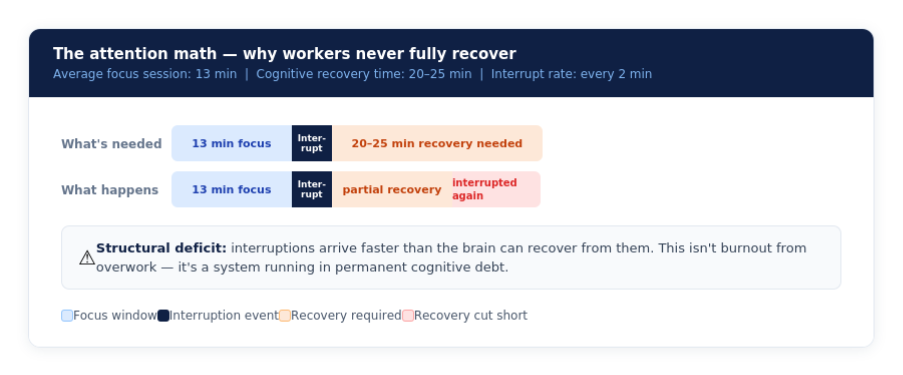
ActivTrak found that the average uninterrupted focus session now lasts just 13 minutes (Source: ActivTrak 2026 State of the Workplace).
The arithmetic is straightforward: workers are being interrupted faster than they can ever fully recover.
AI tools arrive into that environment, add new notification surfaces and new reasons to switch contexts, and organizations call it transformation.
What Attention Loss Looks Like at the Operational Level
Think of it like a codebase with a memory leak. The application runs. Users can operate it. But underneath, resources are being consumed faster than they're released, and the system degrades in ways that are hard to trace to a single cause. No single interruption breaks a person. But 275 of them, compounded across a day, a team, and a quarter. That's where the missing productivity lives.
The pattern is visible in the behavioural data. A developer starts deep work at 9 AM. By 9:13 AM, they're interrupted by a notification. Recovery takes 23 minutes. By the time they're back to full cognitive capacity, another interrupt arrives.
This is structural rather than occasional. In most organizations, this pattern becomes visible long before leadership recognizes it as a productivity issue.
AI tools, dropped into this system without changing the underlying architecture, become part of the interrupt stream rather than relief from it.
Focus is now a managed resource. It degrades under load, requires intentional protection, and cannot be recovered through better software alone. Organizations that treat it as infinite are measuring productivity wrong. They're counting utilization while attention erodes beneath them.
Why Organizations Keep Missing This
There are two reasons, and neither is about investment levels.
First, the cost of fragmentation never makes it into the room where budget decisions get made. Tool adoption is measurable. Utilization is measurable.
What doesn't appear in any dashboard is the cognitive overhead of incomplete recovery or the slow erosion of deep work that produces the highest-value output. The attention leak is invisible until it shows up in performance, and by then the tools are embedded, the norms are set, and the problem is significantly harder to unwind.
By the time the operational impact becomes measurable, the workflows causing it are already deeply embedded.
Second, fixing the environment is harder than buying software and it has no vendor behind it. Redesigning how work flows, protecting focus blocks, reducing notification surfaces, changing meeting culture, all of it requires sustained leadership commitment and produces no immediate metric.
So it doesn't get prioritized. And the attention drain compounds quietly while the adoption numbers look fine. Most dashboards still track utilization rather than the underlying conditions affecting employee productivity.
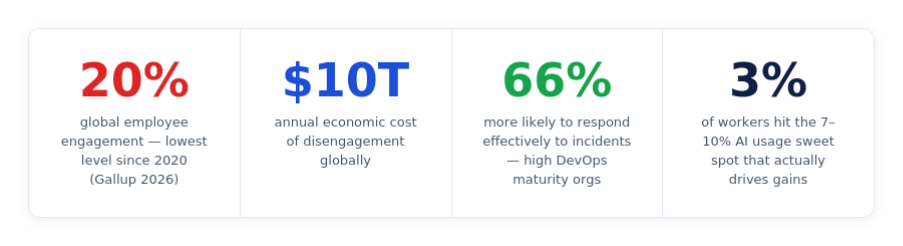
Gallup's 2026 State of the Global Workplace report found that global employee engagement fell to 20% in 2025, the lowest level since 2020, costing the global economy $10 trillion annually (Source: Gallup State of the Global Workplace 2026). Those numbers aren't moving in that direction because people lack tools. They're moving because the operating environment is degrading faster than anyone is measuring it.
Where the Consequences Hit Hardest
The attention tax doesn't hit every team equally. It's sharpest where coordination complexity is highest and in technical teams, that cost has a direct reliability consequence.
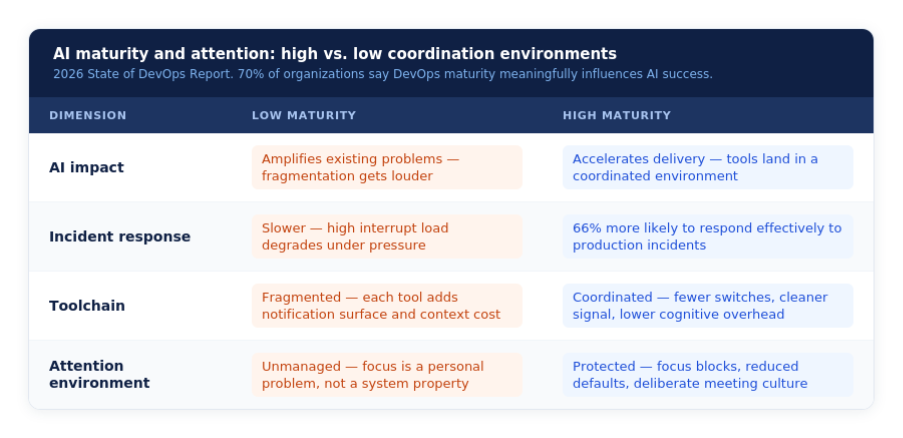
The 2026 State of DevOps Report found that 70% of organizations say DevOps maturity meaningfully influences AI success. High-maturity organizations are 66% more likely to respond effectively to production incidents (Source: Perforce 2026 State of DevOps Report). Low-maturity organizations see AI amplifying existing problems rather than solving them.
A team operating in a high-interrupt, low-focus environment doesn't just produce less work. It produces slower incident response, more coordination overhead during outages, and more cognitive load on engineers already carrying the most complexity. The attention tax is highest exactly where it's least affordable.
When a critical production incident happens, the response window is measured in minutes. But a DevOps engineer in a high-interrupt environment has already lost 20 minutes of cognitive recovery from their last context switch. They're responding at 60% cognitive capacity. That's a system reliability problem, not a minor efficiency loss. The attention tax compounds exactly when the cost of error is highest.
Why AI Adoption Fails Without Workflow Redesign
The question most organizations skip isn't whether AI works. It's whether the workflow it's being dropped into can support it.
You can have the right model and the wrong environment and still see no return. The same principle applies to oversight design, as covered in Human-in-the-Loop as a Production Requirement, the environment the model operates in determines whether the investment returns anything at all.
Even advanced AI powered productivity tools fail when the surrounding workflow increases interruption frequency and coordination load.
ActivTrak identified the productivity sweet spot: teams spending 7 to 10% of their work hours inside AI tools see the clearest performance gains. Below that threshold, the tools are underused. Above it, cognitive overload sets in and gains reverse.
Only 3% of users currently hit that range (Source: ActivTrak 2026 State of the Workplace). The majority are either using AI too little to see results or using it so heavily that it adds to the interrupt load rather than reducing it. That's a workflow design failure rather than a capability failure.
The Hidden Costs of AI Overload, Interruptions, and Context Switching
Most organizations are measuring adoption rates and utilization. Neither tells you whether the work environment is actually functioning.
The hidden productivity costs of AI overload live in what doesn't show up in adoption dashboards. Every context switch carries a recovery cost the next task absorbs. Every notification from a new tool creates another reason to interrupt. Every async update demands immediate response.
These costs compound invisibly. Focus erosion, coordination overhead, interrupted recovery windows. None of these appear in utilization metrics. But they're consuming the gains before they land. That's the real cost of AI overload: attention debt that accrues faster than the organization can measure it.
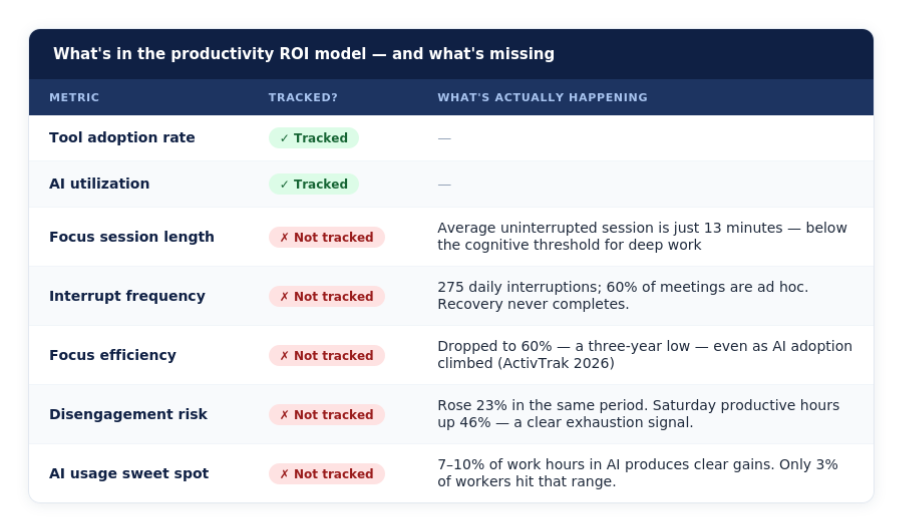
The metric that matters is whether the environment the people are using AI in is designed to protect the attention that makes any of it work.
The costs are invisible because the measurement framework was never designed to see them. Microsoft's Amy Webb put it directly: “if you have a people problem, you will have an AI problem.” She wasn't talking about culture in the abstract but rather about the substrate. The attention environment your people operate in every day is the same infrastructure your AI investment runs on.
Get that wrong and no amount of capability at the model layer will recover what's being lost at the human layer.
This is why the highest-performing teams aren't the ones with the most advanced models. They're the ones that built attention architecture first, then added tools into it. If you're measuring AI success by adoption rates and utilization, you're measuring the wrong thing.
The metrics worth tracking are focus recovery time, deep work hours per engineer, and retention among senior technical staff. Adoption rates tell you the tool is present. These tell you whether it's working.