
What Happens to Middle Management and Span of Control When AI Takes Over Coordination
Updated On:
August 25, 2026

Fewer layers looks like progress on the slide deck. The real cost shows up when 37% of your workforce says they no longer know where they're going.
The restructuring looked clean. Layers came out, headcount dropped, and the org chart finally matched what leadership had been promising for two years. Then, six months later, senior leaders were drowning in operational decisions they shouldn't have been near, frontline teams were waiting longer for direction than before, and somehow nothing was actually moving faster.
Removing a layer doesn't make its work disappear. It redistributes. And in most organizations that have flattened over the last two years, that work moved upward into the calendars of the people who could least afford it.
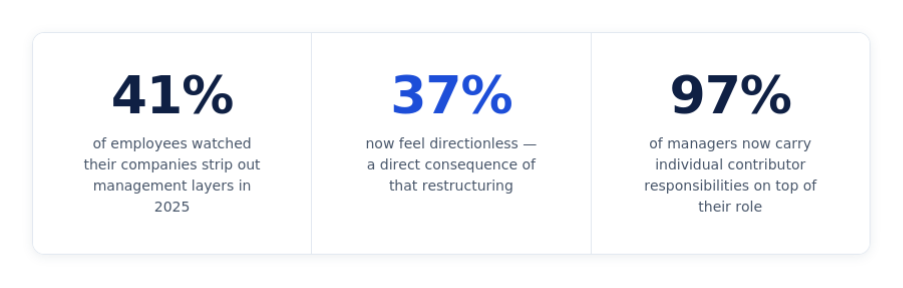
A 2025 Korn Ferry survey of 15,000 professionals found that 41% of employees had already seen their companies strip out management layers. In the same survey, 37% said they now feel directionless. Those two numbers aren't a coincidence. They're the system working exactly as designed, just not the system anyone thought they were designing. (Source: Korn Ferry Workforce 2025 Global Insights Report)
What Happens When Organizations Automate the Middle?
The appeal of removing middle management intensified when AI promised to automate the coordination work they do. But automation absorbed the routine parts. The judgment work had nowhere to go. When you remove the people who synthesized judgment into direction, you don't gain speed. Senior leaders absorb decisions they shouldn't be near, and frontline teams lose the context they need to act.
Removing a Layer Doesn't Remove the Work
The appeal of de-layering is straightforward. Middle management is expensive, resistant to change, and easy to frame as bureaucratic drag. Flatten the hierarchy and you get faster decisions, more accountability at the frontline, a leaner organization.
Then you try to run it. Teams rarely struggle immediately after restructuring. The friction usually appears one or two quarters later, when decision bottlenecks and unclear ownership begin compounding.
Gallup's 2025 data shows that 97% of managers now carry individual contributor responsibilities, spending a median of 40% of their time on non-management work (Source: Gallup State of the Global Workplace 2025). That's not a manager but rather a player-coach model being quietly used as a cost-cutting mechanism. And Korn Ferry's same survey found that 80% of workers would stay in a job specifically because of a manager they trust (Source: Korn Ferry Workforce 2025 Global Insights Report), which means getting this layer wrong isn't just an efficiency concern. At scale, it becomes a retention problem.
The Span of Control Problem Most Organizations Skip
The default approach to de-layering produces a flat pipeline: more direct reports per manager, fewer promotion rungs, the same decision volume spread across fewer people. On paper that reads as agility. In practice it produces attention fragmentation at the top and direction loss at the bottom.
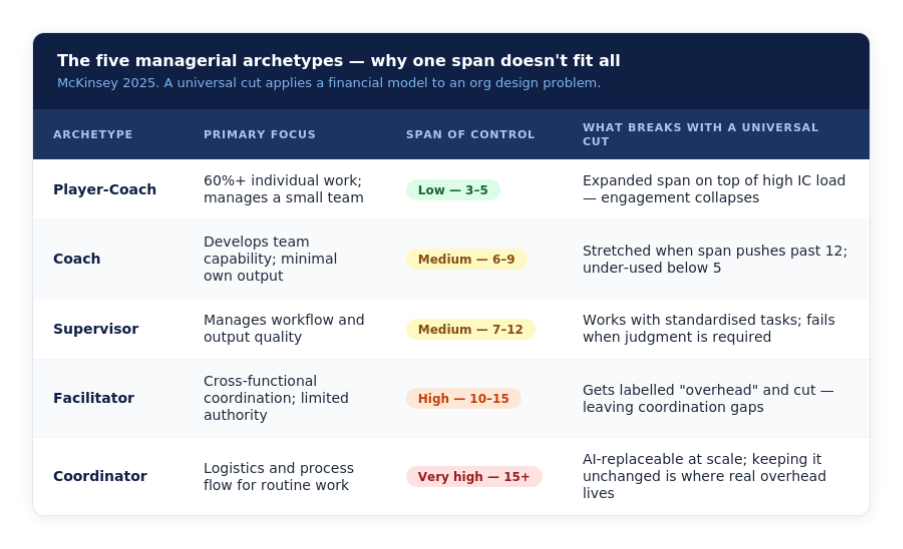
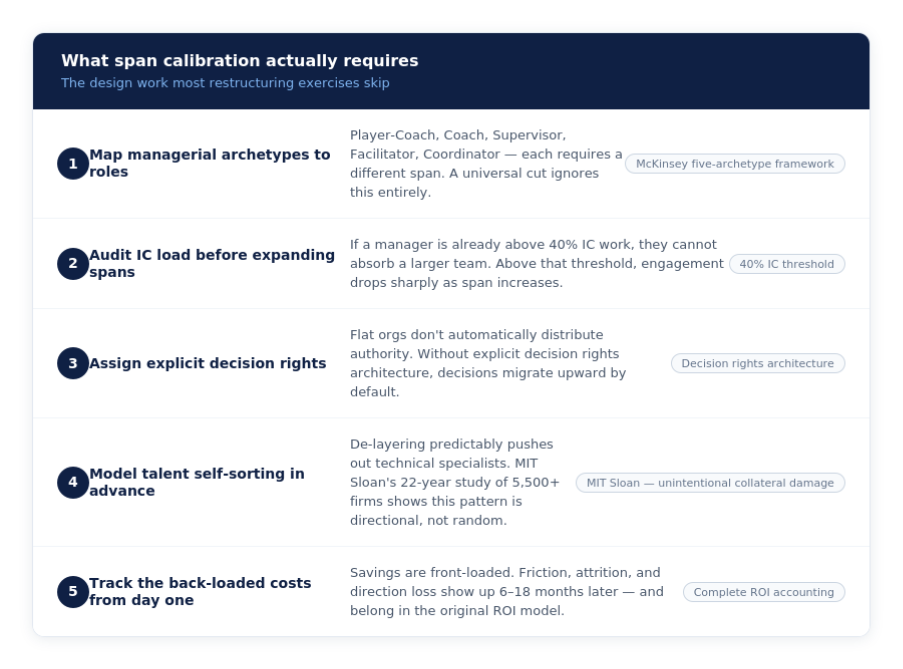
McKinsey's 2025 span-of-control research identifies five distinct managerial archetypes - Player-Coach, Coach, Supervisor, Facilitator, Coordinator - each requiring a fundamentally different span based on work complexity, team skill levels, and process standardization. There is no universal number (Source: McKinsey People & Organizational Performance, 2025). Organizations that apply a universal cut are solving a financial problem with a blunt instrument.
Why Flat Organizations Create More Communication Overhead
Communication overhead rises in flat orgs because coordination shifts from "manager relays context" to "everyone tracks everything directly." AI can handle routing, but not context collapse. When 15 people report to one manager instead of 3, context-switching increases, and decisions that once happened in a 30-minute sync turn into cascading async updates.
Research on CEO time allocation found that doubling span of control reduced solo work time by 6.4% and increased internal coordination meetings by 11% (Source: Harvard Business School, CEO Time Allocation Research). Broader spans don't free leaders. They pull them deeper into coordination. Julie Wulf's fifteen-year study of 300+ U.S. firms found CEO span doubled from 4.7 to 9.8 (Source: Julie Wulf, The Flattening Firm, Harvard Business School), largely by adding corporate staff rather than line managers. The org looked flatter, but power concentrated upward.
McKinsey estimates that rightsizing spans and layers can reduce managerial costs by 10–15%, but only with careful organizational analysis. Companies that flatten indiscriminately rarely achieve those gains.

Why Execution Slows When Management Layers Disappear
The coordination overhead that fills the gap left by removed managers is often driven by tool fragmentation, software rationalization reduces the structural drag before de-layering begins - a structural issue also explored in The $18 Million Hidden Cost of Not Modernizing Your Enterprise Systems.
When middle layers disappear faster than execution coordination infrastructure can adapt, companies face a specific execution gap: decisions get faster but execution slows. Not because the team lacks skill, but because the connective tissue between decision and action thins.
The Hidden Costs of De-Layering Organizations in the Age of AI
There are two reasons most organizations don't catch this early enough, and neither is about capability.
First, the savings are front-loaded and the friction is back-loaded. The headcount reduction shows up in this quarter's numbers.
The directionless workforce, the overburdened senior leaders, and the talent attrition show up show up well after the quarter closes, when they're much harder to attribute to the original structural decision.
Second, span optimization is genuinely complex. A single universal cut is operationally simple. An approach that maps managerial archetype to task complexity to team skill levels, then sets spans accordingly, is a serious organizational design problem that requires real data, real expertise, and real time. Most restructuring exercises skip that work and then wonder why results don't match projections.
The AI Judgment Gap: Automation Can't Replace Human Direction
The hidden costs multiply: automation is supposed to absorb the coordination work, but automation doesn't make decisions or set direction. AI is excellent at automating routine coordination - scheduling, information routing, status aggregation. It's terrible at absorbing judgment.
Middle managers made millions of small judgment calls daily: 'This execution risk matters more than speed here,' or 'This team needs more context because the task is ambiguous.' When you remove that judgment layer and expect AI to compensate, the hidden cost is decision quality degradation that shows up 6-18 months later as execution variance, rework, and strategic misalignment.
The Talent Math That Doesn't Make It Into the Model
MIT Sloan's analysis of more than 5,500 U.S. firms over twenty-two years found that eliminating a management layer doesn't just change the org chart. It changes who stays (Source: MIT Sloan Management Review).
Highly skilled technical specialists - people who derived meaning and status from being the expert others came to - tend to leave when the structure flattens. In a leaner org with fewer defined expert roles, that professional identity disappears.
What the new structure selects for isn't wrong. But the talent quietly pushed out during the process was often the talent most needed to keep.
It also reflects the operational efficiency patterns discussed in What Investors Are Actually Looking for in AI Companies in 2026.
How Restructuring Changes What Keeps People Staying
Korn Ferry found 80% of employees stay because they trust their manager. AI-driven restructuring targets direction, but it does so by removing the person responsible for providing it. You're optimizing away your top retention lever. The skilled technical specialists who leave aren't lazy, they're losing the professional structure that gave their work meaning. AI handles task execution. It doesn't replace the person who explained why the task matters.
Most organizations underestimate how quickly these pressures compound.
AI-driven restructuring hits these three dynamics simultaneously: it narrows employee direction visibility, it crushes the management relationships that predict retention, and it forces span calculations that assume consistent workload - a bad assumption when AI adoption creates uneven ramp periods.
McKinsey's organizational health database, built from over 8 million survey respondents across 2,500 organizations, found that healthy organizations deliver three times the total shareholder returns of unhealthy ones and were 59% less likely to show financial distress during the pandemic.
Internal mobility - one of the first casualties of flattening - makes employees 27% less likely to burn out and 47% less likely to plan to leave (Source: McKinsey Organizational Health Index, 2025). The org chart being redesigned is the same infrastructure the talent strategy runs on.

What Most Restructuring Business Cases Get Wrong
Most decks that got approved this year tracked headcount reduction and layer count and stopped there. The engagement erosion, the decision latency, the coordination friction while the org recalibrates, the senior specialists who quietly left. None of it made it into the model. So the ROI story looked clean. It just wasn't complete.
Gallup's latest estimates put economic cost of low engagement at $8.9 trillion globally, or 9% of GDP (Source: Gallup State of the Global Workplace 2025). Deloitte's 2025 Global Human Capital Trends data - from nearly 13,000 leaders across 93 countries - found that managers currently spend only 13% of their time developing people, and 36% feel insufficiently prepared for the role (Source: Deloitte Global Human Capital Trends 2025).
That's the infrastructure state before span increases. Restructuring into that baseline doesn't improve it.

How to De-Layer Without Losing Direction
The answer isn't adding layers back. It's being precise about what's removed, how spans and decision rights are redesigned, and who can realistically absorb the work. De-layering works best when paired with software rationalization that reduces the coordination overhead caused by fragmented tools.
Research shows managers spending over 40% of their time as individual contributors struggle to absorb larger teams. Below that threshold, wider spans work. Above it, engagement drops quickly. Most restructuring efforts never reach that level of organizational precision.
Companies succeeding with de-layering aren't just cutting managers, they're redistributing management work deliberately - mapping decision rights, redesigning roles, and modeling talent attrition before it happens.
Korn Ferry's data highlights the risk: when management disappears, direction can disappear with it. The companies getting this right know which decisions need fewer gatekeepers, which roles still require judgment, and who actually takes on the remaining work.
That analytical rigor is what separates a leaner organization from a directionless one.
What Recent Research on AI and Middle Management Actually Shows
The organizations getting this right aren't choosing between 'flatten with AI' or 'keep layers' -- they're mapping which work AI can absorb, which decisions genuinely need fewer gatekeepers, and which roles survive because they're about judgment, not coordination.
If you're researching how AI impacts middle management, the recent literature points to three consistent findings: automation doesn't replace coordination, flattening without span analysis creates execution gaps, and retention crises follow within 6-18 months of layer elimination.
Companies that pair de-layering with intentional software rationalization - consolidating the tools that manage workflows, approvals, and coordination - fare measurably better in the transition.