
Why Fractional Executives Deliver More Value Than Full-Time Hires at a Third of the Cost
Updated On:
August 25, 2026

Companies are losing the leadership war because the hiring system they're using hasn't changed in decades, and the talent market underneath it has moved completely.

Here’s what never makes it into the business case. When a senior role goes vacant, the organization doesn’t pause. Transformation continues, the market keeps moving, and operational ownership starts spreading across leaders already covering too much. Strategic decisions slow down, timelines start slipping, and leadership fatigue builds quietly long before a replacement is fully operational.
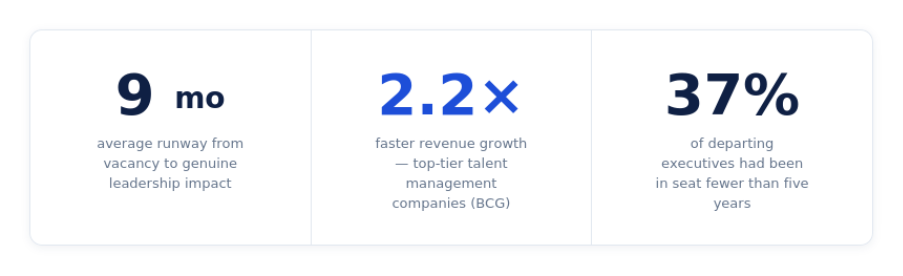
BCG’s Global Leadership and Talent Index is clear: companies in the top tier of talent management grow revenues 2.2 times faster and profits 1.5 times faster than their peers. A single improvement in leadership quality can increase revenue by 15–20%. Every month a critical role underperforms during a slow transition quietly erodes that advantage (Source: BCG Global Leadership and Talent Index)
The market is having the wrong conversation. It's debating who to hire, whether first-time or experienced, internal or external, when the real problem is the system used to find and place people. A system built for a talent market that no longer exists.
The Cost That Never Makes It Into the Deck
When a senior role opens, the response is almost always the same: a search firm is hired, the process takes 12 to 16 weeks, notice periods are served, and then someone joins. But joining is not the same as performing from day one.
McKinsey identifies three gaps behind weak leadership performance: the skill gap, the will gap, and the time gap. A new executive faces all three simultaneously while also being expected to deliver results. (Source: McKinsey & Company, The State of Organizations 2023)
No one creates a line item called cost of leadership vacancy. But the cost becomes visible operationally very quickly. Department heads absorb decisions outside their scope, approvals take longer, transformation work slows down, and already overloaded leaders start operating reactively instead of strategically. None of it appears in a single dashboard. All of it affects performance.
A median S&P 500 company loses $480 million each year due to attrition and disengagement, with the impact concentrating at the executive level (Source: Gallup, State of the Global Workplace). Because the cost spreads across teams and time, it goes unmeasured and gets left out of the decisions that would change it. That's exactly why the system doesn't change.
What Are the Hidden Costs of Hiring Full-Time Executives?
Most organizations track the search fee. Almost none track the nine-month gap between a role opening and the new hire actually leading anything. Decisions fall to people who were never meant to make them, timelines slip, and teams stall. That cost is real, it just never shows up in one place on any dashboard.
The Talent Market Moved and the Hiring Infrastructure Didn't
The traditional executive hiring model was built on assumptions that have quietly collapsed: that the best senior talent was fully employed and had to be recruited away, that long tenures were the norm, and that leadership expertise was scarce and geographically concentrated.
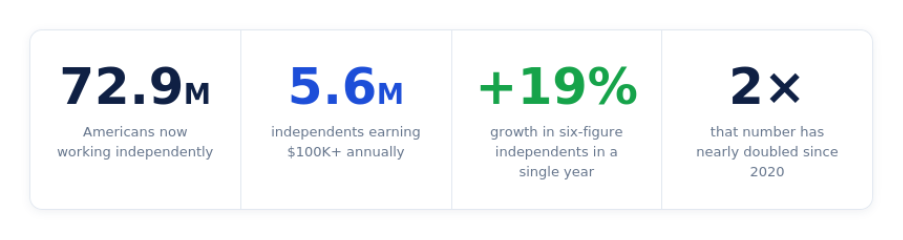
72.9 million Americans now work independently, and the fastest-growing segment isn't junior freelancers - it's senior professionals who chose to leave full-time roles on their own terms. 5.6 million independents now earn over $100,000 annually, a number that grew 19% in a single year and has nearly doubled since 2020 (Source: MBO Partners, State of Independence 2025).
These are people who ran functions, led transformations, and sat in the rooms search firms are trying to access - and then decided the permanent model wasn't how they wanted to work anymore (Source: MBO Partners, State of Independence 2025).
The supply of senior, deployable, independent executive talent is larger than it has ever been. But most traditional hiring systems still operate around retained search cycles, long notice periods, and permanent placement assumptions - making highly available independent operators effectively invisible to the process.
The fractional and interim executive model found its opening precisely in that mismatch: a changed supply side meeting an unchanged demand-side process.
The same pattern appears across enterprise AI infrastructure, explored in Why Your AI Agents Are Failing: The Routing Problem Nobody Is Solving, where modern systems are being constrained by orchestration models built for an environment that no longer exists.
When Should a Company Hire a Fractional Executive Instead of a Full-Time Executive?
The clearest signal is timing pressure - when the role is critical and nine months of underperformance isn't an option. Fractional also makes sense when the need is scoped: a transformation, a transaction, a regulatory response. The model matches the engagement to the actual problem rather than building permanent structure around a temporary one.
What Fractional Actually Means in Practice
The term is used broadly, so precision matters.
What Is the Difference Between a Consultant, an Interim Executive, and a Fractional Executive?
A consultant diagnoses and recommends, they hand implementation back to the organization. A fractional or interim executive holds a defined role, makes real decisions, and is accountable for outcomes, not deliverables. One advises, the other leads.
A fractional executive is not a periodic advisor or someone appearing only for quarterly strategy discussions. In practice, they sit inside operational workflows, make decisions in real time, and carry accountability for outcomes alongside the existing leadership team.
A fractional or interim executive is a senior operator with a clearly defined leadership role, accountable for outcomes, embedded in the organization, and making real decisions. And fractional executives bring something the traditional model cannot: deployment speed.
The timeline comparison makes it concrete. A traditional full-time hire moves through a 12 to 16-week search, offer negotiations, a notice period, and then an onboarding ramp into a new environment. Put those stages in sequence and the gap between role opening and meaningful performance is often nine months or longer.
How Long Does It Take a Full-Time Executive Hire to Become Productive?
A traditional hire moves through search, negotiations, notice, and onboarding - nine months or longer before meaningful performance. A fractional executive can be scoped and operational within weeks, having navigated similar challenges across multiple organizations. They are delivering outcomes before the permanent candidate has served their notice.
A fractional or interim executive comes from a pool of experienced professionals who have navigated similar challenges across multiple organizations, whether that's a fractional COO stabilising operations or an interim CFO steering a transaction. An engagement can be defined and operational within weeks, with measurable outcomes delivered before the full-time hire in the parallel timeline has finished their notice period.

For a company mid-transformation, mid-acquisition, or mid-regulatory response, the difference between those two timelines is the difference between executing the moment and watching it pass.
The Failure Rate Nobody Talks About Loudly Enough
2025 was the highest year for CEO turnover since 2010, with 168 new S&P 1500 CEOs named in a single year and 37% of departing executives having been in seat for fewer than five years (Source: Challenger, Gray & Christmas, CEO Turnover Report 2025). A significant share of permanent placements made at the highest level with the most rigorous processes are simply not working out.
The Korn Ferry CEO and Board Survey captures what leaders say when being honest: only 11% feel extremely confident in their organization's readiness, only 7% are confident they can retain the high performers they recruit, and 82% don't believe they consistently hire highly talented people at all (Source: Korn Ferry CEO and Board Survey 2025).
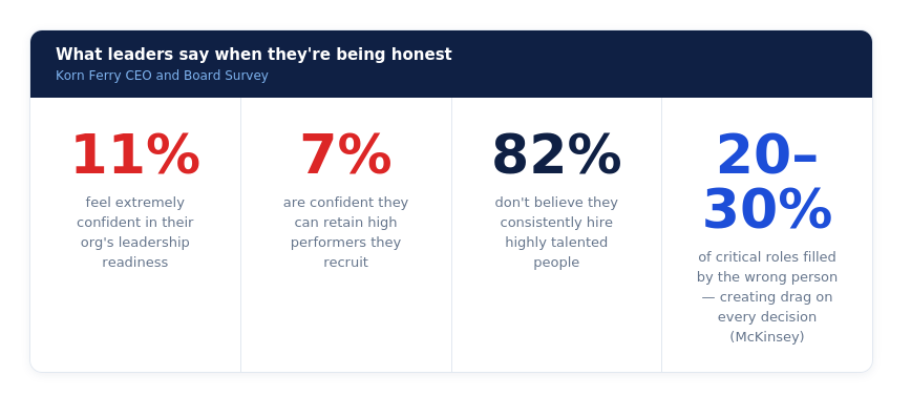
When a permanent placement fails, the costs compound - severance, a second full-fee search, leadership transition done twice, strategic momentum lost across a critical function. And underneath that sits the quieter problem McKinsey identifies: 20–30% of critical roles are currently filled by the wrong person. Not visibly failing, just mismatched enough to create drag across every decision they touch (Source: McKinsey, The State of Organizations 2023).
The fractional model offers something the permanent model structurally cannot: a way to assess real fit under real conditions before any permanent commitment is made. It bounds the downside of a mismatch to something manageable rather than something that requires a crisis response. A fractional COO or interim leader stepping in during that window changes the calculus entirely.
The same principle increasingly shapes enterprise AI governance, as explored in Human-in-the-Loop as a Production Requirement: Why Control Architecture Determines Enterprise AI Success, where oversight architecture determines whether systems remain reliable under real operational conditions.
The Business Case Most Boards Are Still Framing Wrong
Most boardrooms frame contingent leadership as a cost reduction mechanism - cheaper expertise for shorter bursts during tight quarters. That framing consistently leads to underinvestment in what the model actually offers.
The permanent executive model doesn't carry a visible price tag. It carries an invisible one made up of search fees, vacancy periods, onboarding friction, cultural misalignment that surfaces two years in, and severance exposure when the hire doesn't work. None of these appear in a single clean line, which is precisely why they keep getting underweighted.
Can a Fractional Executive Deliver the Same Results as a Full-Time Executive at Lower Cost?
On outcomes, yes - they've navigated similar challenges across multiple organizations and skip the six-month onboarding ramp entirely. The full-time model carries invisible expenses - search fees, vacancy drag, severance exposure - that never appear in the headline number. When those are included, the gap closes faster than most finance teams expect.
A fractional CMO covering a revenue-critical gap during that window rarely appears in the business case but the lost pipeline does.

25% of HR leaders have no standard process for filling unexpected leadership vacancies. That means a quarter of organizations are improvising at the exact moment speed matters most (Source: BCG, What Makes Companies Great at People Management).
BCG confirms the structural fragility: most companies have invested heavily in leadership acquisition and almost nothing in the infrastructure that lets them respond quickly when those acquisitions fail.
Building fractional and interim capacity before a vacancy forces the issue isn't a contingency plan. It's infrastructure. The organizations treating it that way are the ones that won't be scrambling when the seat opens.
The Leadership Advantage That Compounds
The permanent hiring model was designed for a world where talent was scarce, tenures were long, and nine months was an acceptable price for certainty. That world is gone.
72.9 million people now work independently. 5.6 million earn six figures. The fastest-growing segment made that choice deliberately. The organizations that build genuine capability to access this market before they need it - whether through a fractional CMO, an interim CHRO, or a part-time CFO - will have a leadership deployment advantage that compounds, not because they found a cheaper way to fill roles, but because they built a faster and more resilient system than the one everyone else is still running on autopilot.
The nine-month hiring cycle isn't a talent strategy. It's a structural liability that grows every quarter it runs unchanged. Recognizing that distinction is where the real advantage starts.