
What Is the MuleSoft Integration Platform? Anypoint Explained
Updated On:
October 12, 2026

Most teams start evaluating the MuleSoft integration platform at the same point. There are a dozen systems holding overlapping pieces of the customer record, a set of point to point interfaces nobody wants to own, and a roadmap that assumes all of it can be exposed as clean APIs inside two quarters.
Anypoint Platform is Salesforce's answer to that. It covers API design, runtime, management and governance in one place instead of leaving you to assemble those layers yourself. What follows is what actually sits inside it, how the pieces connect, and where it holds up against the rest of the iPaaS market.
What the MuleSoft integration platform actually is
MuleSoft is two things that often get discussed as one. There is the Mule runtime engine, the execution layer with ESB lineage that runs your integration logic. And there is Anypoint Platform, the control plane wrapped around it: design, cataloguing, policy, deployment and monitoring. Salesforce paid $6.5 billion for the company in 2018, and the platform has been built out inside Salesforce since.
Integration logic is built as Mule applications. Each one is a set of flows made up of a source, connectors, DataWeave transformations and error handling, packaged and deployed to a runtime target. You can run hundreds of them and still manage policy, versioning and observability from one console.
The distinction worth holding onto is this. Lighter integration tools treat an interface as a workflow between two systems. MuleSoft treats it as an API product with a lifecycle: spec first, versioned in a registry, discoverable by other teams, and governed by policy applied at a gateway rather than buried in code. That is also why MuleSoft integration software costs more to stand up and pays back differently.
The Anypoint Platform components
Anypoint is modular, and you rarely use all of it on day one. The pieces that matter in practice:
- Design Center and Anypoint Code Builder. Where API specs get written in OAS or RAML and mocked before anything is built. Code Builder is the cloud and VS Code based IDE now carrying most of the work Anypoint Studio used to own.
- Anypoint Exchange. The internal registry for APIs, connectors, templates and reusable fragments. Reuse rates live or die here. If nothing is published to Exchange, you have a set of integrations, not a platform.
- API Manager. Applies policies to deployed APIs: client ID enforcement, OAuth, rate limiting, SLA tiers, IP allowlists. Policies attach at runtime, so security changes do not mean a redeploy of application code.
- Runtime Manager. Deployment, scaling, alerting and log access across every runtime target you use.
- Flex Gateway. An Envoy based gateway that brings non Mule APIs under the same management layer, running at the edge or as a sidecar in Kubernetes. This matters if most of your APIs were never built in MuleSoft.
- DataWeave. The transformation language. Most of the real engineering in a Mule application ends up written here, and it is the main skill gap teams hit.
- Anypoint Monitoring and Visualizer. Metrics, alerts and a dependency graph of what calls what, which becomes useful somewhere past the first fifty APIs.
MuleSoft Composer sits alongside these for click based automation aimed at Salesforce admins rather than engineers. Recent releases also let you expose existing Mule APIs as MCP servers, which is the current route to making a governed API estate usable by agents without rebuilding it.
How MuleSoft works in practice
The architectural opinion baked into the platform is API led connectivity. Interfaces are organised into three layers rather than built per request.
System APIs sit directly on the sources of record and expose them in a stable shape, so a schema change in Oracle or SAP is absorbed in one place. Process APIs hold the business logic that spans systems, the order orchestration or customer onboarding sequence that touches four backends. Experience APIs shape that output for a specific consumer: the mobile app, the partner portal, the agent runtime.
The payoff is not in the first integration. Building the first customer interface this way is slower than writing a direct connection. The second and third consumer of that same system API is where the model earns back, because they build against something that already exists and is already governed.
This is also the part teams get wrong. Without someone owning Exchange and enforcing the layering, you end up with experience APIs talking straight to databases and a platform that costs enterprise money while delivering point to point outcomes.
Runtime Fabric vs CloudHub vs self hosted
The same Mule application can run in three places, and the choice is usually driven by network and compliance posture rather than cost.
- CloudHub 2.0. Runs on MuleSoft managed Kubernetes. You manage apps and replica sizing only. Fits when you want zero cluster ops and can accept managed networking, with private spaces for isolation.
- Runtime Fabric. Runs on your own EKS, AKS, GKE or self managed Kubernetes. You manage the cluster, upgrades, capacity and apps. Fits when data residency, VPC peering or co-location with your data layer is non negotiable.
- Customer hosted. Runs on your VMs or bare metal. You manage everything, including HA and patching. Fits legacy estate constraints, or where Mule predates your cloud.
CloudHub 2.0 deploys by replica, sized in vCores, and handles scaling and failover for you. Runtime Fabric gives you the same deployment model while keeping traffic and data inside your own boundary, at the cost of owning the cluster lifecycle. Most regulated clients we see land on Runtime Fabric for the system API layer and CloudHub for experience APIs, which is a reasonable split.
One practical note on whichever target you pick. An LTS release carries a minimum of 18 months of standard support with six months of extended support behind it, while Edge releases run a few months each. Clusters left on an unsupported Mule runtime are the single most common reason a MuleSoft estate becomes a modernization project two years later.
MuleSoft vs other iPaaS
The comparison is less about connector counts than about what you are optimising for.
MuleSoft is strongest where interfaces are long lived, have multiple consumers, carry complex transformation logic, and need enforceable governance across business units. Deep Salesforce alignment helps if that is your core system. The trade is build cost and a specialist skill set.
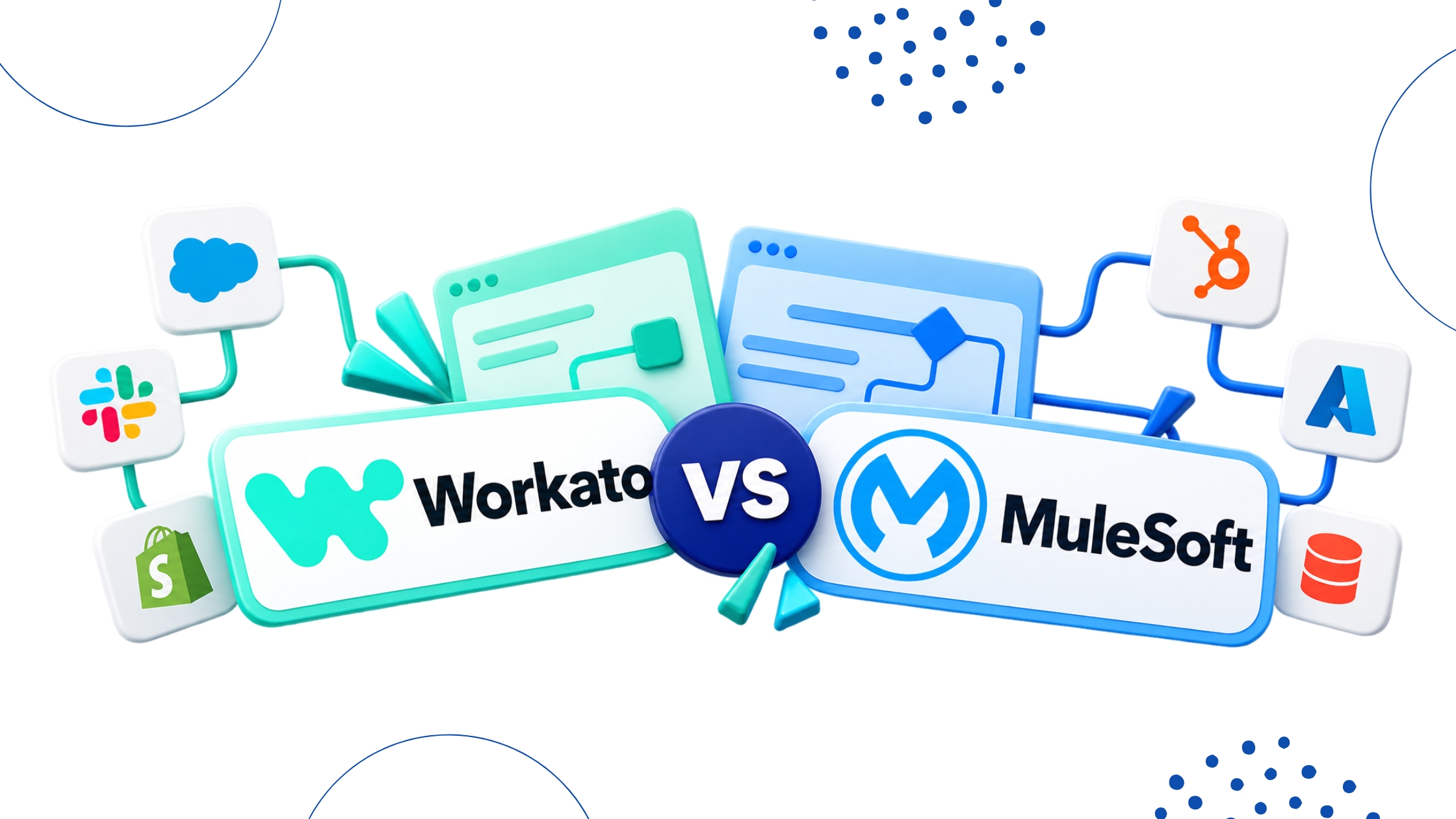
Workato and similar automation platforms optimise for speed across SaaS. Event driven recipes, a shorter build cycle, and a surface that semi technical teams can operate. For process automation across your GTM and finance stack, MuleSoft is usually heavier than the problem requires. Boomi sits between the two, lighter to deploy than MuleSoft with a reasonable governance story. Azure Integration Services makes sense when you are already committed to Azure and want consumption pricing.
The pattern worth considering is not either or. A governed API layer in MuleSoft over the systems of record, with a lighter automation platform handling process work on top of those APIs, gives you control where it matters and speed where it does not. We implement both, and the split is usually clearer after mapping which interfaces have more than one consumer.
What it costs you beyond licensing
Three things tend to be underestimated in the business case.
Skills are the first. DataWeave and Mule flow design are not transferable from general backend engineering, and the hiring market for experienced Mule developers is thin. Budget for enablement or a partner bench, not just seats.
Governance is the second. The platform gives you the tooling to run an API program. It does not run one for you. Without naming an owner for Exchange standards, naming conventions and policy templates, you get sprawl that is harder to untangle than the point to point mess you replaced.
Upgrade cadence is the third. Runtime versions, connector versions and Java baselines all move, and the gap between a working estate and a supported one widens quietly.
If you have fifteen SaaS applications, no API program and no multi consumer interfaces, this is more platform than the problem needs.
Making the call
Three questions usually settle it. How many consumers does a typical interface have, now and in eighteen months? How strict are your residency and policy requirements? And can you staff DataWeave and API governance, internally or through a partner?
If the answers point to multiple consumers, real compliance constraints and systems of record you expect to keep for a decade, the MuleSoft integration platform is a defensible choice. If they point to SaaS process automation with a small team, something lighter will get you there faster.
At Linksoft we work on both sides of that line, including MuleSoft implementations, runtime migrations off unsupported versions, and cases where the honest answer was a different platform.