
The Data Breach Cost Gap: Why $10.22 Million Is the Wrong Number to Manage To
Updated On:
August 25, 2026

The US data breach cost isn't a cybersecurity headline anymore. It's a business model failure. The gap between how fast attacks scale and how slowly companies recover is the most underreported structural crisis in enterprise risk today.

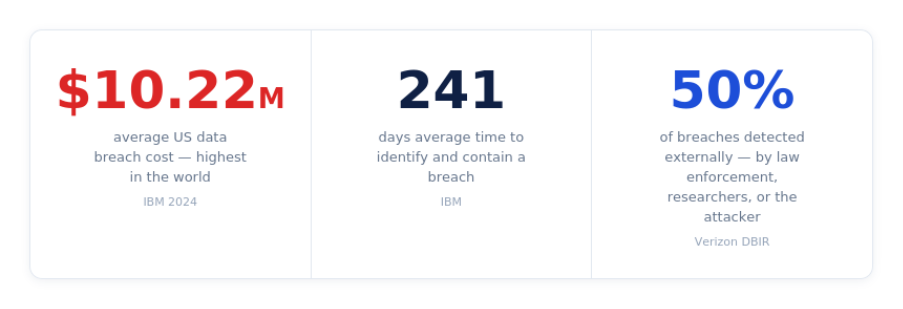
Half of breached organizations learn about it from someone else - law enforcement, a researcher, or the attacker via a ransom demand. The rest detect it internally, but only after an average of 241 days. That's a business continuity failure most leadership teams have never priced.
The average US breach costs $10.22 million. Globally it's $4.44 million, but the spread matters more than the average (Source: IBM Cost of a Data Breach Report 2024). Costs concentrate, compound, and in the US - where regulation, litigation, and customer expectations intersect - they hit hardest. Healthcare data breach cost alone averages $9.77 million, the highest of any sector for fourteen consecutive years.
Most organizations manage to the cost number instead of the recovery arc. What a breach costs at disclosure is the least important part. The real question, the one few can answer before they need to, is what recovery actually looks like. That's the gap this piece addresses.
What the 241-Day Number Actually Means
This figure circulates constantly in board decks and vendor pitches, usually accompanied by dramatic language about attackers living inside networks for months. The number is real. The framing almost always isn't.
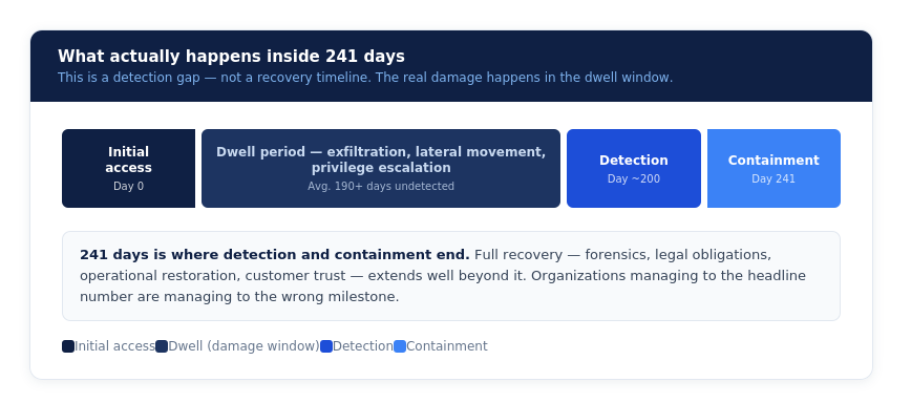
241 days is the identify-and-contain timeline, not full recovery. Full recovery, restoring operations, managing legal obligations, rebuilding customer trust, takes considerably longer and varies based on the nature of the breach. A company hit with ransomware faces a fundamentally different curve than one whose database was silently exfiltrated over six months.
Think of it like a hospital. Stabilizing a patient in the ER and discharging them fully recovered are two completely different timelines. 241 days is the ER number. Nobody tracks what happens after, and that's where most of the cost actually lives.
Why Are Data Breach Costs Increasing Even When Companies Spend More on Cybersecurity?
Because spending is concentrated on prevention, and the cost is concentrated on recovery. Most security budgets are weighted toward tools that stop attacks at the perimeter, not toward the detection density, legal readiness, and operational resilience that determine what a breach costs once it's inside. The gap between those two investments is where breach costs keep compounding, regardless of what the prevention budget looks like.
The Verizon DBIR confirms that 50% of breaches are detected internally; the other half are discovered by law enforcement, researchers, or the attacker themselves (Source: Verizon Data Breach Investigations Report 2024). When an organization is the last to know, every decision in the first 72 hours is made on incomplete information against an attacker who has had months of context.
How Long Does It Actually Take a Company to Recover From a Data Breach?
241 days is where detection and containment end, not where recovery begins. Full recovery, covering forensics, legal obligations, regulatory response, operational restoration, and customer trust, extends well beyond it and varies significantly by breach type. Organizations managing to the 241-day number are measuring the wrong milestone and underpricing the actual recovery arc by a significant margin.
Ransomware Is No Longer What You Think It Is
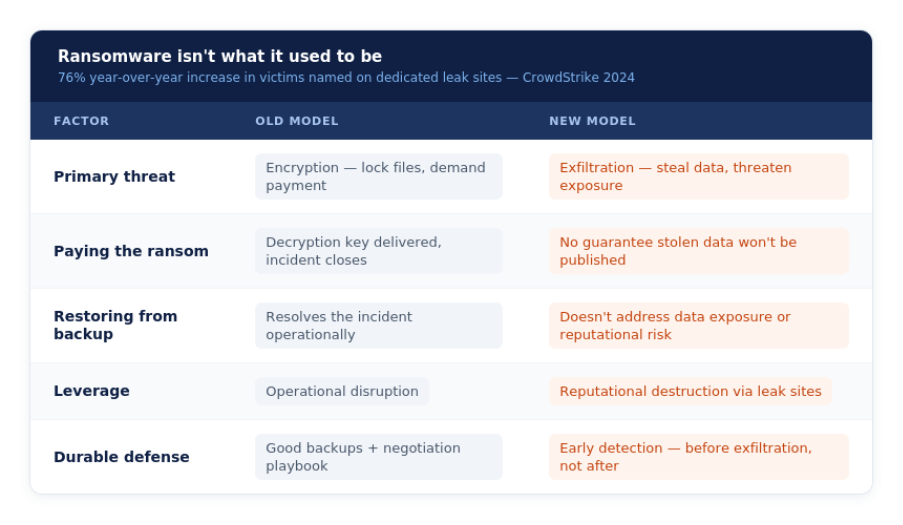
The word ransomware has become a catch-all, and that ambiguity is damaging how organizations model their risk. When most boards hear ransomware, they picture encryption: lock the files, demand payment, restore from backup or negotiate. That mental model is outdated, not wrong. And acting on an outdated model produces outdated defenses.
Verizon DBIR data shows 23–32% of confirmed breaches involve ransomware or extortion, depending on how extortion-only cases are counted (Source: Verizon Data Breach Investigations Report 2024). That range matters because the attack has structurally changed. Encryption is increasingly the secondary threat. The primary leverage is now exfiltration and exposure - attackers steal the data first, then threaten to publish it regardless of whether a ransom is paid or systems are restored.
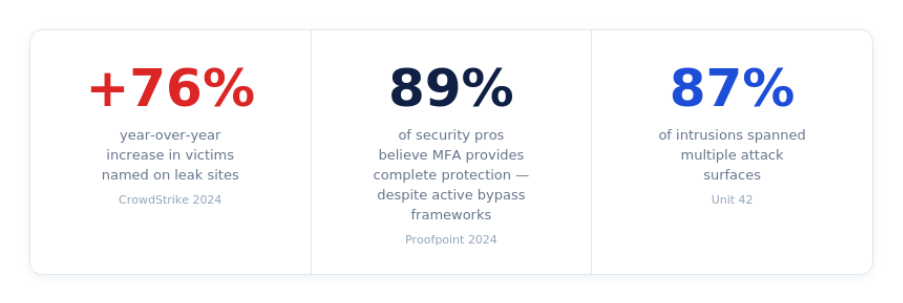
CrowdStrike's 2024 report found a 76% year-over-year increase in victims named on dedicated leak sites (Source: CrowdStrike 2024 Global Threat Report). That's not a ransomware-as-encryption story. That's a reputational destruction story. Paying no longer guarantees the data won't surface. Restoring from backup no longer makes the incident go away. Ransomware recovery, in the modern extortion model, isn't a technical process but a reputational one.
Organizations still modeling this as a file-encryption problem are solving for an attack that no longer exists in its original form.
How Has Ransomware Changed and Why Are Traditional Defenses No Longer Enough?
The attack changed structurally. Encryption was the leverage. Exfiltration is now the primary threat. Attackers steal the data first, then threaten exposure regardless of whether a ransom is paid or systems are restored. Backup restoration doesn't close that exposure. Paying doesn't guarantee silence. The defenses built for the old model - good backups, a negotiation playbook - were designed for a threat that has largely moved on.
AI and the Attack Surface
The AI-powered cyberattack narrative has reached saturation. Every threat briefing features some version of it. The reality is more specific, and understanding the specificity matters more than accepting the generalization.
Hoxhunt's Phishing Trends Report, drawn from 50 million phishing simulations and real attack data across 2.5 million users, shows phishing now runs on a Phishing-as-a-Service model where technical barriers have collapsed and volume is the primary strategy. AI's contribution is real, but it's about scale and cost efficiency - not a proven step-change in success rates. Attackers can generate personalized, convincing lures at a volume that would have required significant human effort three years ago.
The threat isn't a super-phisher with an unprecedented strike rate. The threat is that targeting every person in an organization simultaneously has become economically viable. Defenses sized for a certain volume of attack are now operating in a different environment without having changed at all.
The same dynamic - tools deployed into structures not built to absorb them - runs through enterprise AI adoption as well, as outlined in Why Enterprise Productivity Is Still Dropping Despite AI Adoption.
How Is AI Changing Cybersecurity Threats and Phishing Attacks?
AI's real contribution to the threat environment is economic, not technical. It collapsed the cost of generating personalized, convincing phishing lures at scale making it viable to target every person in an organization simultaneously. The strike rate hasn't changed dramatically. The volume has. Defenses calibrated for a certain attack frequency are now facing a different operating environment without having been recalibrated.
Proofpoint's 2024 research found that 89% of security professionals believe MFA provides complete protection - despite MFA-bypass frameworks like EvilProxy already operating at scale (Source: Proofpoint State of the Phish 2024).
The defense isn't obsolete. Treating it as a complete solution is. That distinction is where most organizations are currently sitting without realizing it.
The Structural Imbalance
What gets lost when the conversation stays on individual statistics: the actual problem is structural, not tactical. It's the imbalance between how fast attacks scale and how slowly organizational recovery compounds.
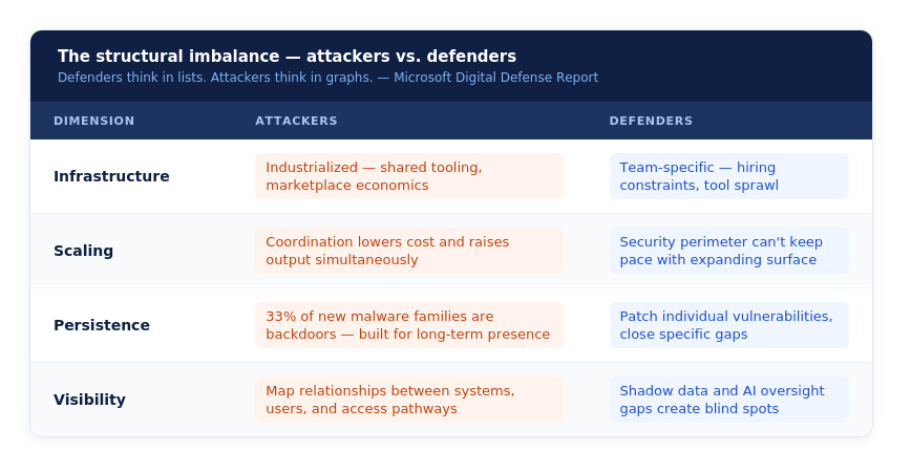
Attackers operate with industrialized infrastructure, shared tooling, and marketplace economics that lower cost and raise output simultaneously. Unit 42's Global Incident Response Report found that 87% of intrusions spanned multiple attack surfaces, with identity weaknesses involved in more than half (Source: Palo Alto Networks Unit 42 Incident Response Report 2024).
Mandiant's M-Trends report - grounded in 500,000+ hours of frontline investigations - found that 33% of newly tracked malware families are backdoors, built for long-term presence rather than a single strike.
Defenders operate in conditions that don't scale the same way. Security teams face hiring constraints the threat landscape doesn't. Tool sprawl creates visibility gaps attackers actively exploit. IBM flagged shadow data - information in unmanaged sources security teams cannot see, let alone protect - as a growing exposure point. For regulated industries, where healthcare data breach cost compounds through mandatory reporting and litigation, that exposure is existential.
Microsoft's Digital Defense Report puts the asymmetry most directly: defenders think in lists, attackers think in graphs. One side closes specific gaps. The other maps every relationship between systems, users, and permissions - finding connections no individual control was designed to protect. That asymmetry isn't a budget or headcount problem. It's architectural, and architectural problems don't get solved by buying another tool.
The cost of deferred infrastructure decisions compounds in ways that rarely appear on a single balance sheet, a pattern examined in detail in The $18 Million Hidden Cost of Not Modernizing Your Enterprise Systems.
What Resilience Actually Requires
The cost numbers are real, but the recovery narrative is wrong. $10.22 million is a legitimate anchor for US breach risk modeling. But 241 days is a detection and containment figure, not a recovery timeline. Organizations that understand this distinction make better resilience decisions than those managing to the headline number.
Ransomware is an extortion problem, not an encryption problem. When attacker leverage is data exposure rather than operational disruption, backup restoration doesn't resolve the incident and paying doesn't guarantee silence. Ransomware recovery starts before the ransom demand, which is at detection, not disclosure.
AI is changing the economics of attack, not just the mechanics. Volume and cost efficiency are its real contributions to the threat environment. The response isn't to outspend attackers on tools. It's to raise the cost of attack through detection density, identity hardening, and architectural visibility - making the economics work against the attacker rather than in their favor.
The structural imbalance between attack scaling and organizational recovery is the defining risk problem of this period. It doesn't resolve through any single tool, vendor relationship, or compliance framework. It resolves through better system design - the same principle that separates organizations that manage incidents from organizations that become case studies in how incidents manage them.
What Should Companies Prioritize to Improve Cyber Resilience Instead of Just Buying More Security Tools?
Detection density over perimeter spend. Early detection - catching intrusions before exfiltration, not after - is the only lever that changes the breach cost arc. Identity hardening reduces the attack surface that matters most. Architectural visibility closes the gaps that tool sprawl creates. None of these are products, they're design decisions. The organizations separating themselves aren't outspending attackers, they're making the economics of attack work against the attacker instead of in their favor.