
99% of Companies Are Running AI Transformation. 84% Haven't Restructured a Single Job
Updated On:
August 25, 2026

Everyone's rewriting their operating model. Almost nobody has built the structure to execute it. That distance is where most AI transformations quietly collapse.
There's a version of the CIO's job that gets talked about in conferences and strategy decks: the AI orchestrator, the innovation partner, the executive coordinating intelligent systems across every business function. It sounds right. It's directionally true. And it's about two to three years ahead of where most organizations actually are.
The delivery responsibility didn't go away when AI arrived, CIO responsibilities expanded. The structure underneath them didn't, it just got company. Governance landed on the same desk. So did organizational redesign, AI strategy, and oversight for systems that make decisions autonomously. All of it added. None of it replaced. The org chart, reporting structure, and accountability model largely unchanged.
That gap, between what the CIO is now responsible for and what the organization has actually been built to support, is the most expensive structural problem in enterprise technology right now. Most companies haven't operationalized the implications of it yet.
The Narrative Is Running Ahead of the Reality
The story being told in most boardrooms goes like this: the CIO has evolved from IT delivery head into AI orchestrator, sitting at the center of enterprise strategy. It makes for great slides. The deployment numbers don't support it yet.
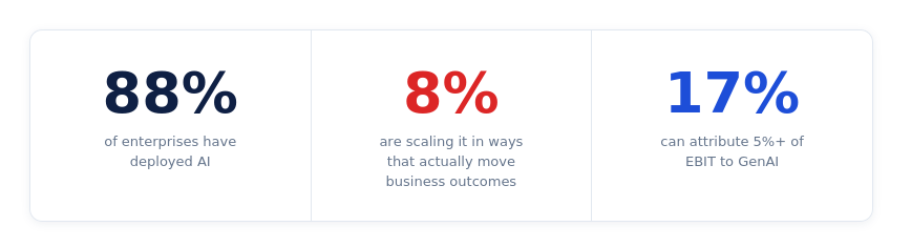
74% of companies have yet to generate tangible value from their AI investments - not struggling toward value, but with nothing meaningful to show. Only 39% of organizations have seen measurable profit impact from AI at all. And despite a 50% jump in workforce access to AI tools in a single year, only 60% of those people use those tools daily (Source: Deloitte, State of AI in the Enterprise 2026).
The distance between access and actual productivity is explored in detail in Why Enterprise Productivity Is Still Dropping Despite AI Adoption.
Access isn't adoption. Adoption isn't value. Value isn't transformation. Most enterprises are navigating the long stretch between those words, and the CIO's job is to close that distance while the gap keeps widening.
The role is being made significantly heavier by AI orchestration.
Why Are Companies Investing in AI But Not Restructuring Jobs and Workflows Around It?
Because restructuring is harder to budget for than software. Buying a tool has a line item. Redesigning job architectures, rebuilding team structures, and rerouting workflows don't. So, they get deferred. The technology gets funded but the organization that needs to absorb it doesn't. That gap is where most AI investments go quiet.
Three Numbers That Explain the Execution Gap
The technology is compounding faster than anyone predicted. The human infrastructure around it is not. And the liability for closing that gap has landed on the CIO's desk - whether the mandate, the budget, or the reporting structure reflects that or not.
According to Deloitte's 2026 research: 84% of companies have not redesigned jobs or work around AI capabilities - not slowly, not partially, but not at all. Only 21% have a mature model for governing autonomous AI agents, already making consequential decisions inside live processes.
Only 16% have adopted new organizational structures that reflect how AI-augmented teams need to operate (Source: Deloitte, State of AI in the Enterprise 2026).
The operating model is changing. The agents are being deployed. The job architecture, governance layer, and org chart itself haven't moved at anything close to the same pace.
How Should Companies Redesign Jobs and Teams for AI Adoption?
Start with the actual work. Map what each role actually does, identify where AI is already making decisions in that workflow, and redesign around the new division of labor. BCG's research is unambiguous: 70% of AI transformation value comes from people and process changes, not the technology. Most enterprises have that ratio exactly backwards.
The Budget Is Wired Backwards
BCG's research on companies actually generating real value from AI surfaces something that should make most CIOs uncomfortable about how their budgets are currently structured. The companies winning have almost completely inverted how most enterprises spend.
70% of resources go to people and process, 20% to technology and data and 10% to algorithms (Source: BCG, Closing the AI Impact Gap). That's how AI leaders allocate. Most enterprises are running the exact inverse - with 93% of AI funding going directly to technology and 7% left for everything human.
Amanda Luther at BCG put the implication directly: “two-thirds of effort and resources on people-related capabilities is what transformation actually requires.”
You cannot automate around a structural problem. Buying a better model doesn't redesign job architectures, and deploying more agents doesn't build the governance layer needed to oversee them.
How Is the Role of the CIO Changing in the Age of AI?
The CIO's job didn't get lighter, it got structurally heavier. Governance, organizational redesign, AI strategy, and oversight for autonomous systems all landed on the same desk. None of it replaced the delivery mandate. All of it was added to it. The role is now less IT head and more organizational architect, except most organizations haven't updated the reporting structure, budget, or headcount to reflect that.
The Governance Gap Is Moving in the Wrong Direction
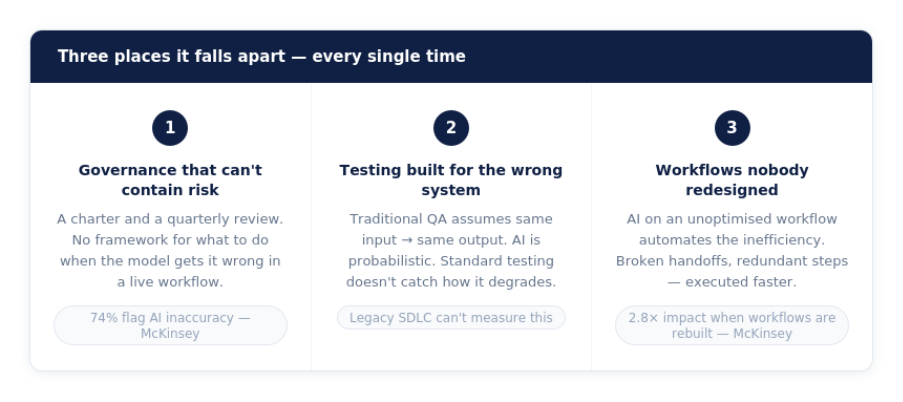
Autonomous AI agents are being deployed faster than the frameworks designed to manage them are being built. That gap isn't theoretical. As autonomous AI agents move into mission-critical processes, the exposure compounds in ways that are very difficult to retroactively govern.
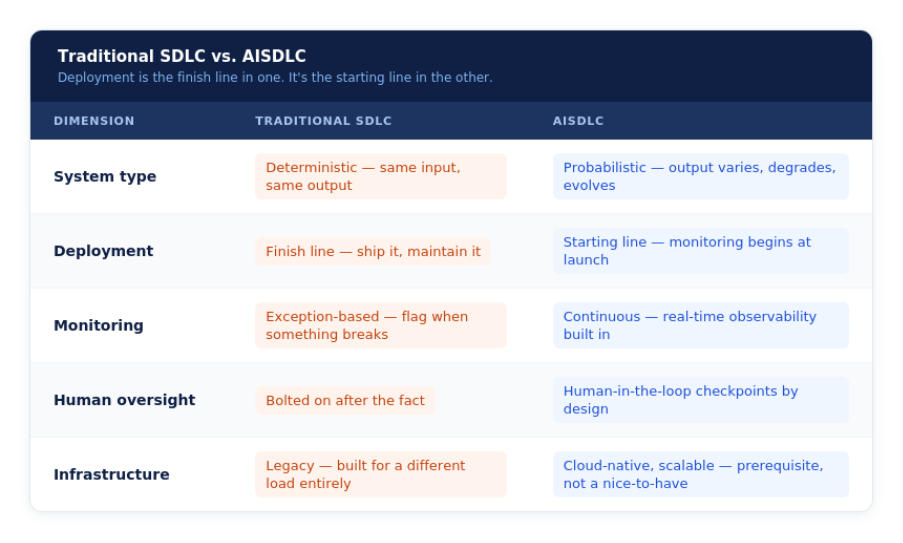
51% of organizations have already experienced at least one negative consequence from AI use in an era where most deployments are still relatively contained (Source: McKinsey & Company, The State of AI in 2025).
Why Do AI Transformations Fail Even After Deploying the Right Technology?
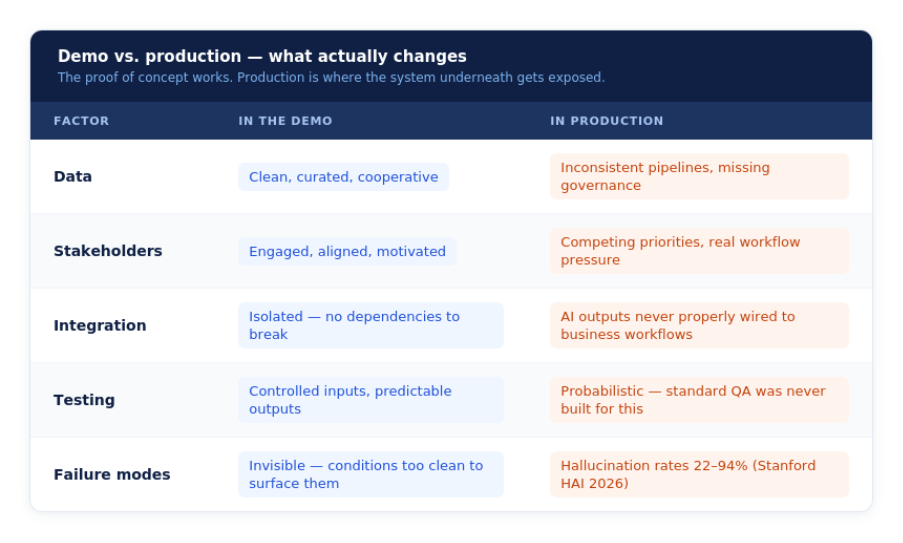
Because the technology was never the constraint. Governance frameworks that can't contain autonomous systems, job architectures nobody redesigned, and budgets still wired toward models rather than people - these are what break AI transformations. The model performs in the demo but the organization around it wasn't built for what comes next.
Pressure is arriving from three directions at once: the business wants faster deployment, the board wants assurance that autonomous systems aren't creating liability, and regulators - particularly in Europe, where 77% of companies now factor a vendor's country of origin into selection decisions - want auditability and sovereignty guarantees (Source: Deloitte, State of AI in the Enterprise 2026).
The organizations getting ahead of this aren't slowing deployment. They're building the oversight layer in parallel, so that when deployment scales, governance scales with it rather than chasing it. Build it after the scale event and you're retrofitting a live system - a categorically different and more expensive problem.
What Actually Needs to Happen
Job redesign has to become a CIO deliverable. The conversation about rebuilding role architectures is already shifting as outlined in Middle Management Trends 2025.
The conversation with the CHRO about rebuilding role architectures around AI capability isn't adjacent to the mandate right now. It is the mandate. Deferring it is how enterprises end up with sophisticated tools being used by teams that were never redesigned to use them well.
Governance has to be built before the scale event, not after it. Every framework retrofitted into a live agentic system cost more, breaks more, and creates more organizational friction than one built in parallel from the start. The case for governance investment has to be made before the negative consequence, not in response to it.
What Governance Framework Should Companies Build for AI Agents and Autonomous Systems?
Build it before the scale event, not after. The framework needs to define decision rights - what the agent can do autonomously, what requires human review, and what gets escalated. It needs auditability built in from the start, not retrofitted. And it needs to be treated as infrastructure, not compliance. The organizations retrofitting governance into live agentic systems are solving a categorically harder problem than the ones that built it in parallel.
McKinsey's research on top-performing companies shows they insource technology capability at nearly double the rate of their peers - building internal expertise rather than managing AI as outsourced labor. The institutional knowledge of how an enterprise's AI systems actually work is a structural asset. Outsourcing it means outsourcing the advantage that compounds over time.
The Structural Lag Most Organizations Are Sitting In
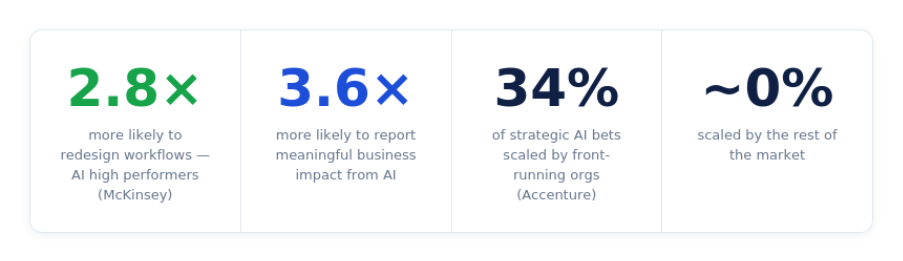
The CIO's role didn't get replaced. It got rewritten by AI transformation without the org chart to match. It got much heavier, and the structure around it hasn't kept pace. Delivery still has to run, governance has to be built from scratch and job architectures that haven't changed in a decade need to be redesigned around systems that didn't exist three years ago.
All of it is happening inside organizations where 93 cents on the dollar still flows toward the technology rather than the people who need to use. And CIO responsibilities keep compounding with no corresponding change to mandate, budget, or headcount.
Reid Hoffman's observation that AI, like most transformative technologies, grows gradually then arrives suddenly describes exactly where most enterprises are right now. The structural lag is the gradual part. The sudden part is coming, and the org chart won't move on its own.
The organizations actually generating value from AI aren't running the most sophisticated models. They're running the most coherent structures around people, process, and oversight - and they got there by treating organizational design as the technology problem, not a separate conversation to have later.